
Solar Eclipses: Shadow and Safe Viewing
The August 12 eclipse crosses the North Atlantic and Europe; see why totality is narrow and how to watch safely.
Course introduction
About this course
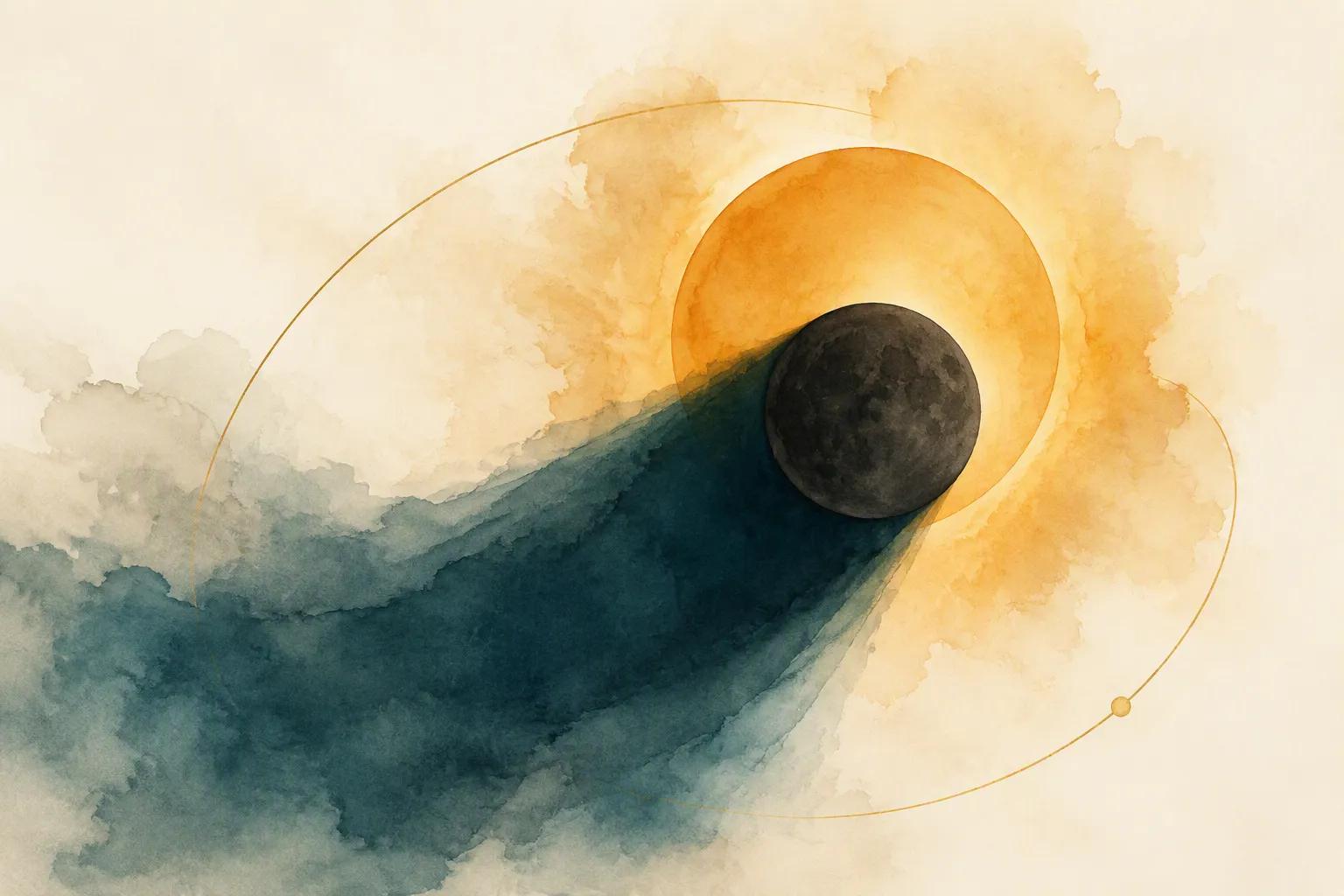
On August 12, 2026, the Moon’s shadow will cross Greenland, Iceland, northern Russia, the Atlantic Ocean, Spain, and a small corner of Portugal. A much wider area will see a partial eclipse. The difference comes from where an observer stands within the Moon’s shadow: the umbra is the small inner region where the Sun is completely covered, while the penumbra is the broader outer region where only part of it is hidden.
This course makes that moving geometry easy to picture. You will understand why eclipses do not happen every month, why totality follows a narrow path, and why the Sun’s faint outer atmosphere—the corona—appears only when its bright face is fully covered.
Safe viewing is essential. During every partial phase, look only through eclipse glasses or a handheld solar viewer designed for direct solar viewing; ordinary sunglasses are not sufficient. A telescope, binoculars, or camera needs a special solar filter fitted to the front. Only observers inside the path of totality may look without protection, and only while the Sun is completely covered. A pinhole projector offers a safe indirect view.
Continue in Henri
Turn this introduction into your course.
Henri asks about your background, goal, and time, then starts the syllabus in the right place for you.